1898: What’s the story?
Whether viewing “Fritz’s Establishment”, the 1898 delivery service, Albertina Traver and her Great-Grandmother” sharing a special moment, “W. Stickle at the Gas Works” pausing a moment from his hard day of labor to pose with his dog, or smiling with “Two Boys with Flowers”, the photos curated for this edition of “From the Archives” reveal human emotions, settings around town, and sometimes the fashions of the time.
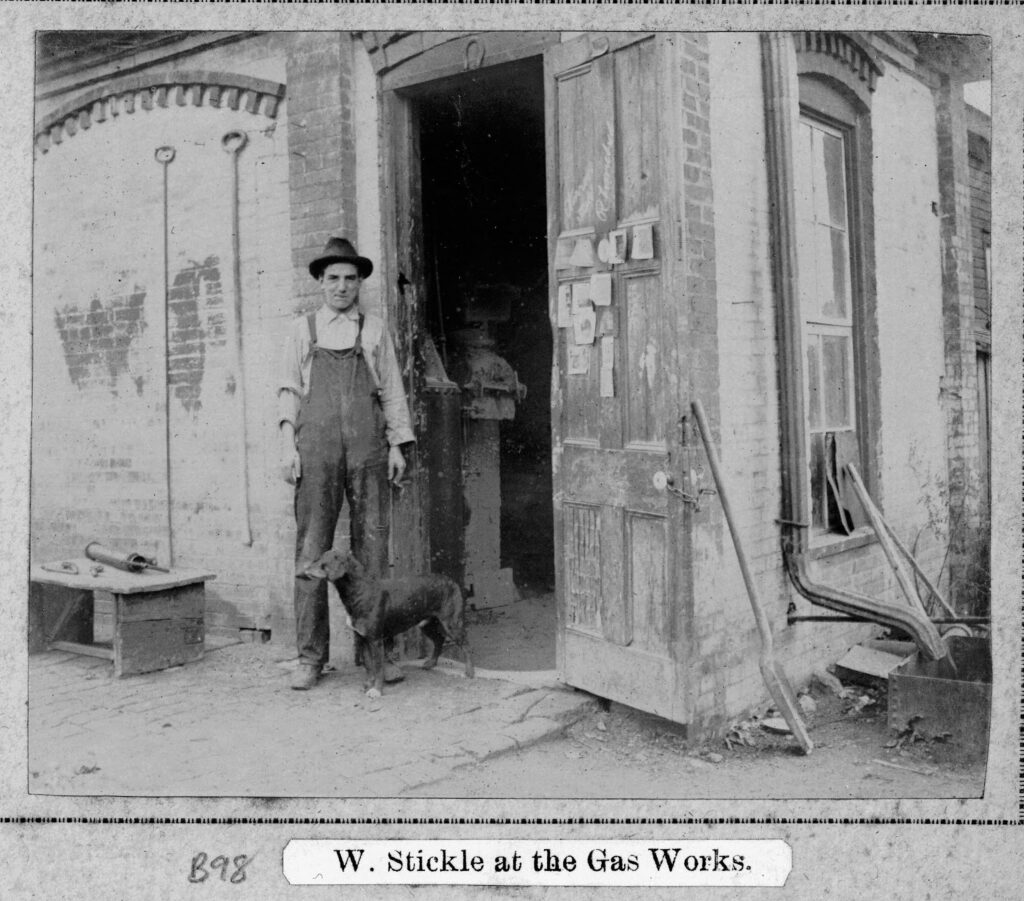
Leaning against the dusty brick building that houses the gas works, W. Stickle wears overalls, a hat, and a cotton shirt. A dog poses with him.
The Stickle name originates from the original Palatine settler with the German version of the surname.
“W. Stickle at the Gas Works”; Rhinebeck Photograph Album; Photographer: unknown; 1898; 1995-049.63.3.
An unidentified man, perhaps a businessman, wears more formal attire and stands in front of a building in town. Where is the dog heading?
“Man with Pipe and Dog”; Rhinebeck Photograph Album; Photographer: unknown; 1898; 1995-049.10.6.
A younger unidentified man enjoys posing in front of a mural. His attire is closer to what appears on the Fashion Institute of Technology’s Fashion History Timeline for the 1890s.
“Man in Front of Mural”; Rhinebeck Photograph Album; Photographer: unknown; 1898; 1995-049.15.5.
Ready made men’s clothing was available for sale in Poughkeepsie by 1879. Whereas in 1843, Peter Schultz purchased gambroon, twilled muslin, silk thread, buttons, handkerchief, and a cravatt for young William R. Moore.
99-66-012
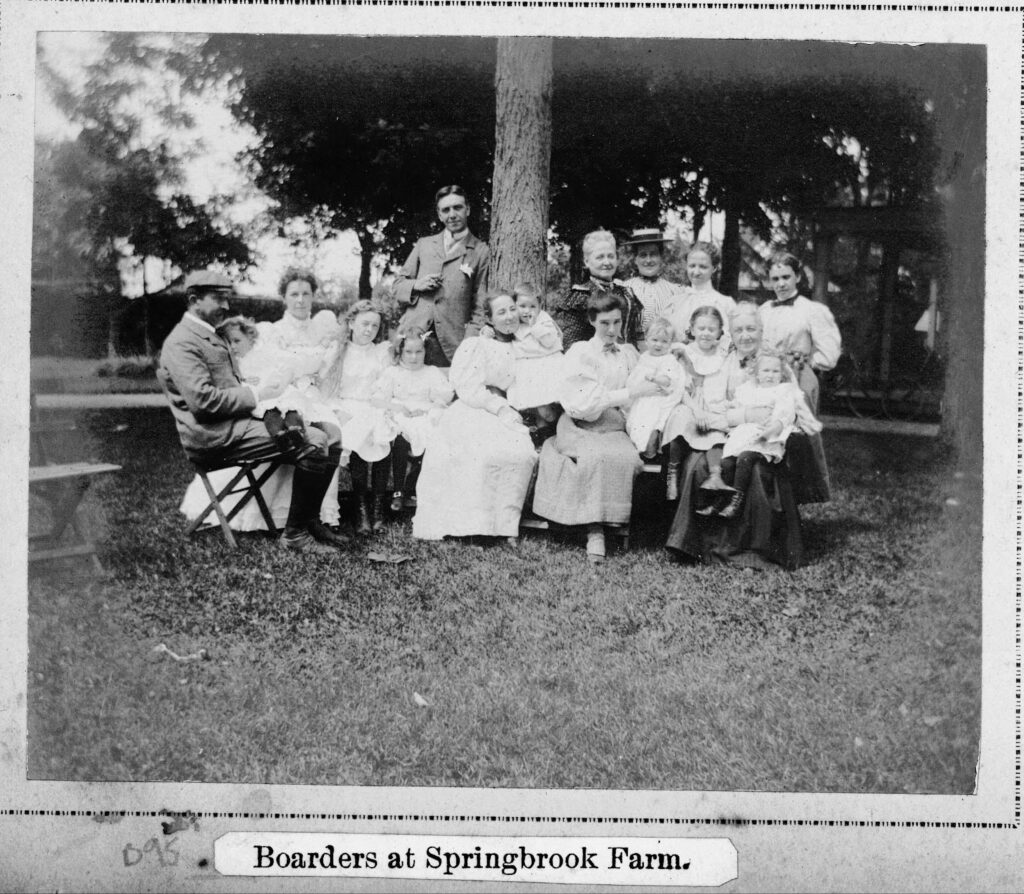
“Boarders at Springbrook Farm”, perhaps a family, make a fashionable group of all ages. Note the apparel and hairstyles representative of the era.
Unfortunately, groups of boarders are not identified in the Album.
“Boarders at Springbrook Farm”; Rhinebeck Photograph Album; Photographer: unknown; 1898; 1995-049.62.4.
Mrs. Schaad, with hands clasped, stands at the corner of a residence. The gigot sleeves tapering from puffy at the shoulder to fitted below the elbow were popular. There was a Jacob Schaad who owned a bakery at 55 East Market Street in 1876. “Mrs. Schaad”; Rhinebeck Photograph Album; Photographer: unknown; 1898; 1995-049.40.5. |
Note the sleeves and the facial expressions. The emotions displayed on these sisters could be seen in any family today. What’s the story? What are they revealing about family dynamics? What are their secrets? Why aren’t these three sisters identified in the album?
“Three Sisters”; Rhinebeck Photograph Album; Photographer: unknown; 1898;1995-049.40.2.
An Albertina Traver descended from the Ten Broeck and Schultz families became a librarian in Poughkeepsie and collected data on libraries throughout the county. Her name is on a folder at the FDR Library. The file has not been viewed.
“Albertina Traver and Great-Grandmother”; Rhinebeck Photograph Album; Photographer: unknown; 1898;1995-049.44.3.
Pure joy! Although the boys wear the hats and clothing of 1898, they appear to have just returned from running barefoot in the garden. Their emotions and their story are timeless.
See you in February!
From the Archives,
Researcher Bonnie Wood
January 2026